They've Never Met You, But You'd Bail Them Out of Jail: The Wild Psychology of Loving Strangers Online
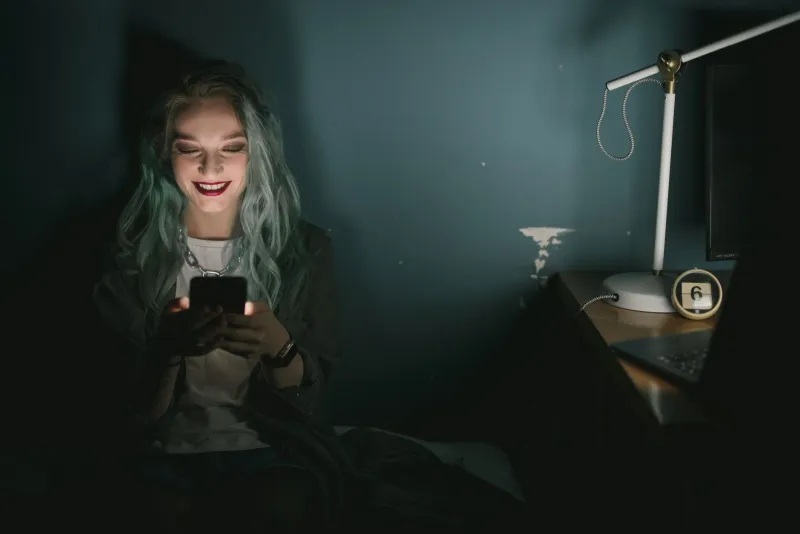
Let's set the scene. It's 11:47 PM on a Tuesday. You're horizontal on your couch, phone hovering six inches above your face, watching a creator you've followed for four years talk about their situationship drama like it's a campfire story. You feel concerned. You feel invested. You might even feel a little protective. And then — just for a split second — you remember: this person does not know your name. They do not know you exist. If you passed them on the street in Nashville or walked by them at a Trader Joe's in Burbank, they would not even clock you.
And yet, here you are, emotionally activated over their problems like they're your college roommate.
Welcome to the parasocial friendship paradox — one of the most quietly widespread psychological phenomena of the digital age, and one that almost nobody talks about honestly.
Your Brain Was Not Built for This
Here's the thing: your brain is old. Like, embarrassingly old in terms of software updates. The neural architecture you're running on was designed tens of thousands of years ago for a world where you only ever encountered a few hundred people in your entire lifetime. Back then, if someone talked to you regularly, shared personal stories, made eye contact (or the ancient equivalent), and showed up in your daily life — that person was real. That person was yours. Your brain filed them under "close relationship" and released the appropriate bonding chemicals accordingly.
Fast forward to now. A creator posts a "get ready with me" video every single morning. They talk directly into the camera — directly at you — in a confessional, intimate tone. The algorithm, bless its chaotic little heart, has figured out that you like this person and keeps serving you their content. Over months, maybe years, you accumulate thousands of hours of one-sided interaction. Your brain, running its ancient relationship software, starts tagging this person as significant.
Dr. Pamela Rutledge, a media psychologist who has studied parasocial relationships extensively, has described this process as the brain "doing exactly what it's supposed to do" — it's just that the inputs have changed dramatically. The brain can't easily distinguish between someone speaking at a camera and someone speaking to you. The intimacy cues are identical. The emotional processing is the same.
So no, you're not weird for feeling like you know your favorite podcast host. You're just running legacy code in a world that moved faster than evolution could keep up with.
The Algorithm Is Playing Matchmaker (And It's Ruthless)
If the brain's architecture is the kindling, the algorithm is the lighter fluid. Modern content platforms are extraordinarily good at personalization — and that personalization doesn't just affect what you see, it affects how attached you get.
Think about it this way. When you first stumble onto a creator, you might watch one video. If you engage, the platform serves you another. Then another. It learns your watch time patterns, your engagement spikes, the exact moment you pause or rewind. It builds a profile of your preferences so precise it would make a stalker blush. And then it uses that profile to keep feeding you content that hits your specific emotional sweet spots.
The result? Your parasocial relationship doesn't develop randomly — it's curated. The algorithm is essentially a very efficient, very amoral matchmaker that pairs you with creators engineered (sometimes intentionally, sometimes not) to feel like your people. You're not just watching content. You're being matched.
This is categorically different from how previous generations engaged with celebrities. Your grandmother might have loved Johnny Carson, but she watched him at 11:30 PM for thirty minutes, five nights a week, in a format that was clearly a television performance. There was a stage. There was a desk. There was a band. The artifice was visible.
Now? Your favorite creator is lying in bed, no makeup, talking about their anxiety in a voice that sounds like a whisper specifically meant for you. The performance is invisible. The intimacy feels undeniable.
When the Illusion Cracks
Ask anyone who's been deeply invested in a parasocial relationship about the moment they realized the connection wasn't mutual, and you'll get a surprisingly emotional answer.
There's a particular kind of disorientation that happens when a creator does something that doesn't match the person you thought you knew. They get into a controversy. They say something that feels out of character. They go through a breakup you saw coming before they did. Or — perhaps most jarring — they meet a fan in real life and treat them like a stranger, because to them, that fan is a stranger.
Fans in online communities describe this as "the reset" — the sudden, stomach-dropping awareness that all that intimacy was directional. It flowed one way. You knew them. They knew a version of themselves they'd chosen to present. And that version was never quite the whole person.
This isn't necessarily the creator's fault. It's the fundamental structure of the medium. But it doesn't make the emotional whiplash any less real.
The Gray Zone: When Parasocial Gets Complicated
Here's where it gets genuinely thorny. Not all parasocial attachment is harmful, delusional, or even particularly problematic. Researchers are pretty clear on this. Parasocial relationships can offer real comfort to lonely people. They can model healthy communication styles. They can make people feel less isolated during difficult periods — a fact that became painfully obvious during the pandemic, when creators essentially became the primary social interaction for millions of Americans stuck at home.
The issue arises when the parasocial relationship starts substituting for real connection rather than supplementing it. When someone declines social invitations because they'd rather stay home and watch their favorite streamer. When a creator's opinion carries more weight than a friend's. When the sense of intimacy becomes so convincing that a fan starts expecting reciprocity that was never on the table.
The line between parasocial-as-comfort and parasocial-as-replacement is blurry, and the platforms have exactly zero financial incentive to help you find it.
What Do You Do With This Information?
Honestly? Probably nothing dramatic. You don't need to unfollow everyone you've ever felt emotionally connected to. You don't need to write a formal letter of resignation from your favorite creator's parasocial inner circle.
But maybe — just maybe — it's worth occasionally poking at the feeling. Asking yourself: what is this connection actually made of? Is it built on genuine insight into who this person is, or is it built on thousands of hours of carefully curated content designed to feel like insight?
Because here's the genuinely wild part. The parasocial friendship paradox isn't a glitch in the system. It's not a bug your brain developed from too much screen time. It's the system working exactly as designed — by evolution, by platforms, and sometimes by creators who are very, very good at making you feel seen.
You're not broken for caring about people who don't know you exist. You're just human, doing very human things, in a world that got very strange very fast.
Welcome to the internet. Your parasocial best friends are waiting.